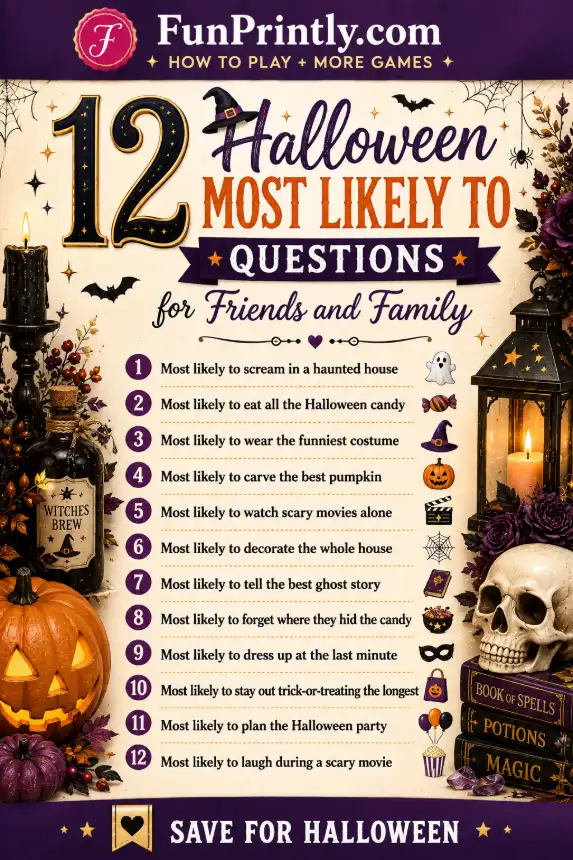
Halloween is a perfect excuse to see how well your friends and family really know one another. Who would panic first in a haunted house? Who would secretly finish the candy bowl? And who would still be planning their costume five minutes before the party starts?
These 12 Halloween Most Likely To questions turn those playful predictions into a quick group game for Halloween parties, family gatherings, sleepovers, classroom celebrations, or the time before everyone heads out trick-or-treating.
There are no right answers and no complicated setup. Read a prompt, give everyone a moment to decide, and let the group point to the person who fits it best. Some choices will be obvious, others may split the room, and a few could surprise everyone.
The questions stay light and family-friendly, covering haunted houses, candy, costumes, pumpkins, scary movies, decorating, ghost stories, and Halloween party habits.
How to Play Halloween Most Likely To
Gather everyone where they can comfortably see one another.
One person reads a question aloud. Give players a few seconds to decide, then count down:
Three… two… one… point!
Everyone points to the person they think best matches the prompt.
You do not need to award points. The reactions and explanations are usually more entertaining than keeping score.
For larger groups, players can write down a name instead of pointing. At a dinner table, you can simply vote verbally.
Keep the teasing friendly. If a question makes someone uncomfortable, skip it and move on. Halloween Most Likely To works best when everyone feels included in the joke.
12 Halloween Most Likely To Questions
1. Most likely to scream in a haunted house
There is usually one person who insists they are not scared – and then jumps at the first unexpected noise.
Think about who would make it through a haunted house calmly and who would be gripping someone else’s arm before reaching the second room.
For an extra conversation starter, ask what would scare them most: a ghost, a clown, a spider, or something suddenly moving in the dark.
2. Most likely to eat all the Halloween candy
This one may produce an immediate unanimous vote.
Choose the person who would keep returning to the candy bowl, hide a favorite treat for later, or somehow notice exactly where the best candy is being kept.
After the vote, ask everyone to name the Halloween candy they would be least willing to share.
That usually creates a second debate without needing another official question.
3. Most likely to wear the funniest costume
Some Halloween costumes are spooky. Others are elaborate. Then there are the costumes designed entirely to make everyone laugh.
Vote for the person most likely to choose an unexpected character, create a ridiculous homemade costume, or commit completely to a joke that only makes sense after they explain it.
If everyone is already dressed up, this prompt can double as an informal costume category.
4. Most likely to carve the best pumpkin
Who has the patience to turn a plain pumpkin into something impressive?
The winner might be the artistic person in the group, the perfectionist who would spend an hour fixing tiny details, or someone who always finds a surprisingly creative idea.
With younger children, you can treat this as decorate the best pumpkin instead of focusing on carving. Pumpkin painting, stickers, and other age-appropriate decorating options can keep the question relevant without requiring sharp tools.
5. Most likely to watch scary movies alone
Watching a scary movie in a room full of friends is one thing. Choosing to watch it alone at night is very different.
Think about who would genuinely enjoy the experience rather than spending half the movie hiding behind a pillow.
If your group includes people who do not like horror, ask what they would choose instead: a funny Halloween movie, a mystery, a classic monster movie, or something completely non-scary.
6. Most likely to decorate the whole house
One pumpkin by the front door is enough for some people.
Others would cover every available surface with bats, cobwebs, lights, skeletons, candles, signs, pumpkins, and whatever else fits the theme.
Choose the person most likely to turn decorating into a full project.
If that person is hosting the current Halloween party, the group may not need much time to decide.
7. Most likely to tell the best ghost story
A good ghost story is not only about the plot. The storyteller has to know when to slow down, when to pause, and when to deliver the creepy part.
Vote for the person who could keep everyone listening even if the story began with something ordinary like an old house, a strange sound, or a door that should have been locked.
If the group wants to continue, let the chosen storyteller invent the first sentence of a Halloween story and have everyone add one line.
8. Most likely to forget where they hid the candy
Hiding candy sounds like a clever idea until nobody can remember where it went.
The obvious vote may go to the most forgetful person in the group, but someone might also be chosen because they would create such a clever hiding place that even they could not find it again.
This question works especially well with family members and close friends who already know one another’s habits.
9. Most likely to dress up at the last minute
Some people know their Halloween costume weeks in advance.
Others start searching through closets shortly before they need to leave.
Choose the person most likely to build an entire costume from whatever is already in the house.
As a quick follow-up, ask everyone what last-minute costume they could create in ten minutes. The answers can become surprisingly inventive.
10. Most likely to stay out trick-or-treating the longest
Who would keep suggesting “just one more street” after everyone else is ready to head home?
This person is probably determined to make the most of every stop – and every possible piece of candy.
Adults can answer based on what they were like as children if they no longer trick-or-treat themselves.
For real trick-or-treating plans, keep children appropriately supervised and follow the boundaries your family normally uses for nighttime activities.
11. Most likely to plan the Halloween party
Every celebration seems to have one person who naturally starts organizing.
They are thinking about decorations, snacks, games, music, costumes, invitations, and what everyone will actually do once they arrive.
Vote for the person most likely to take charge of the entire Halloween party.
If the host receives every vote, consider that confirmation that the group has been paying attention.
12. Most likely to laugh during a scary movie
Not everyone reacts to scary scenes by screaming.
Some people laugh when everyone else jumps, find the dramatic music amusing, or start making jokes at exactly the moment the movie is trying to build suspense.
End the round by deciding who is most likely to ruin a tense horror scene by laughing.
Then ask the chosen person whether they genuinely find scary movies funny – or whether laughing simply makes them less scary.
Make Everyone Vote at the Same Time
One small rule can improve the game considerably: do not let players point immediately.
If the first person chooses someone, others may simply follow.
Instead, have everyone decide privately and reveal their answer after a countdown.
Three… two… one… point!
Seeing five people suddenly point at the same family member is much more entertaining than watching votes appear one at a time.
For bigger groups, written names work in the same way. Everyone writes a choice, then reveals it together.
Try a “Predict the Vote” Version
You can add a light scoring element without changing any of the 12 questions.
Before reading each prompt, choose one player to predict who will receive the most votes.
Then read the question and let everyone vote normally.
If the prediction matches the group’s most popular choice, that player earns one point.
Rotate the predictor for each round so several people get a turn.
This variation works particularly well with families and longtime friends because players are not only answering the question – they are trying to anticipate how everyone else thinks.
Use the Questions as Halloween Conversation Starters
You do not have to rush through all 12.
Some prompts may lead naturally to stories.
After the haunted house question, someone might remember a time they were genuinely frightened at a Halloween attraction. The last-minute costume question may lead to stories about costumes that did not go according to plan.
Let those conversations happen.
A Most Likely To game becomes repetitive when the host treats every question as “read, point, next.” Giving the best prompts room to develop makes the activity feel more personal to the group.
On the other hand, not every question needs a five-minute discussion. If everyone votes and laughs, move on.
Halloween Most Likely To With Kids and Mixed Ages
The questions in this set stay on light Halloween topics, which makes them useful for groups containing both children and adults.
Younger players can simply point to someone. They do not need to explain every choice.
Older kids and adults may enjoy defending their vote or telling a related story.
Avoid forcing a child to be the center of attention if they do not enjoy it. You can also play in family teams, with each pair or team deciding on one person together.
If the same player receives nearly every vote, change the rhythm. Ask players to choose someone who has not been picked recently, or let that person become the reader for the next few questions.
The aim is shared laughter, not making one guest the permanent target.
When This Game Works Best
Halloween Most Likely To is useful because it does not require a dedicated section of the party schedule.
You can play while guests are arriving, around the dinner table, before trick-or-treating, during a sleepover, after eating, or while everyone waits for another planned activity.
It also works well between more structured games.
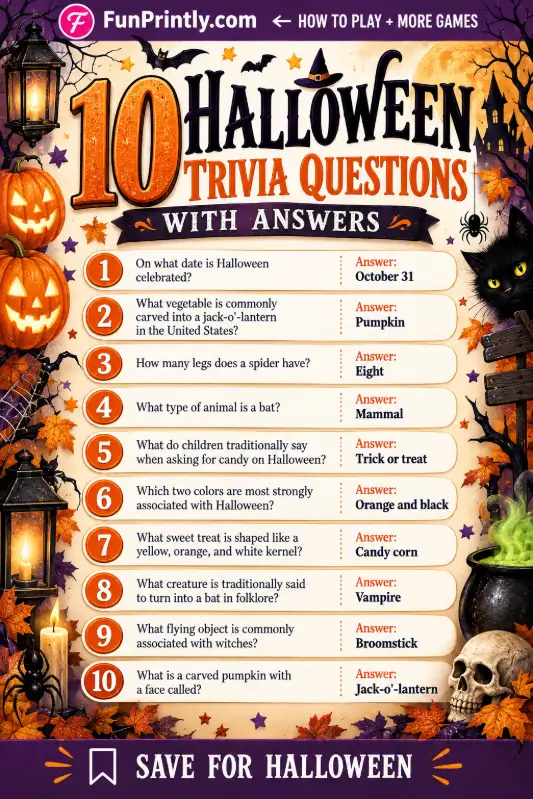
For example, a party could move from Halloween trivia into these Most Likely To questions and then into Halloween Would You Rather, Halloween This or That, or Halloween Charades.
Changing the style of play helps the activities feel distinct rather than turning the party into one long question game.
Do You Need to Play All 12?
No.
For a short party gap, choose four or five questions.
For a family game night or sleepover, use all 12 and let the conversations last longer.
Because the prompts are independent, stopping halfway does not leave an unfinished game. You can return to the remaining questions later if the group wants another round.
This also makes the list useful as a backup activity. If another party game ends earlier than expected, you already have something that can begin in seconds.
Keep the Jokes Friendly
Most Likely To games depend on people making judgments about one another, so the tone matters.
Halloween themes make it easy to stay playful: costumes, candy, pumpkins, movies, parties, and imaginary haunted houses give you plenty to work with without touching genuinely personal subjects.
Do not pressure someone to explain a vote if they would rather move on.
You can also allow players to vote for themselves. Sometimes the person most likely to eat all the Halloween candy knows exactly who they are.
Frequently Asked Questions About Halloween Most Likely To
How do you play Halloween Most Likely To?
Read one prompt aloud and let everyone decide who in the group fits it best. After a countdown, players point to that person or reveal a written name.
There are no correct answers. The group is comparing opinions.
Are these Halloween Most Likely To questions suitable for kids?
Yes. The prompts focus on family-friendly Halloween topics including candy, costumes, pumpkins, decorating, movies, ghost stories, parties, and trick-or-treating.
For younger groups, keep explanations simple and make participation relaxed.
How many people can play?
Three or four people are enough, although a larger group creates more possibilities for split votes.
For very large gatherings, divide guests into smaller tables or use written voting instead of pointing across the room.
Do we need any supplies?
No special supplies are required.
You can read the questions directly from the FunPrintly graphic or from this article. Pens and paper are only useful if you prefer private voting or want to add the prediction version.
Do you keep score in Most Likely To?
Usually not.
The standard version is about seeing who receives the votes. If your group wants competition, use the Predict the Vote variation and award points for correctly guessing the majority choice.
Can we play only some of the questions?
Absolutely.
Use a handful for a quick activity or all 12 for a longer round. Each question works independently, so there is no required stopping point.
See Where the Halloween Votes Land
The most entertaining rounds are often the ones where everyone makes the same choice instantly – or where one person is completely shocked to discover what their friends and family think.
Keep the voting quick, let the strongest questions turn into conversation, and leave the weaker debates behind instead of forcing them.
You do not need elaborate rules to make this Halloween game work. You just need a group that is ready to point fingers.
SAVE FOR HALLOWEEN
More Halloween Party Games
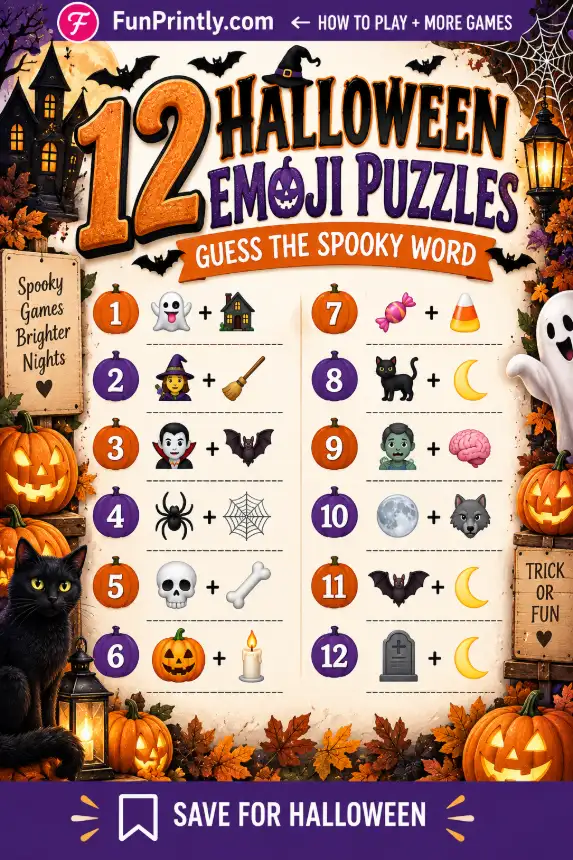
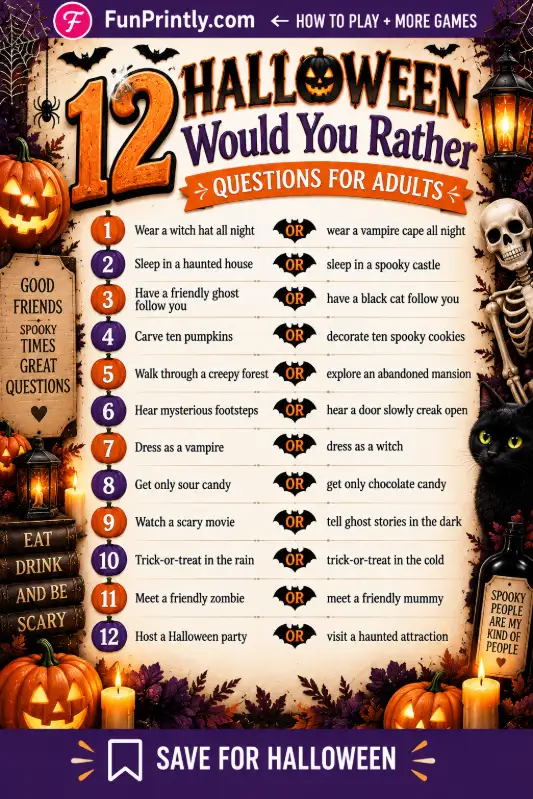
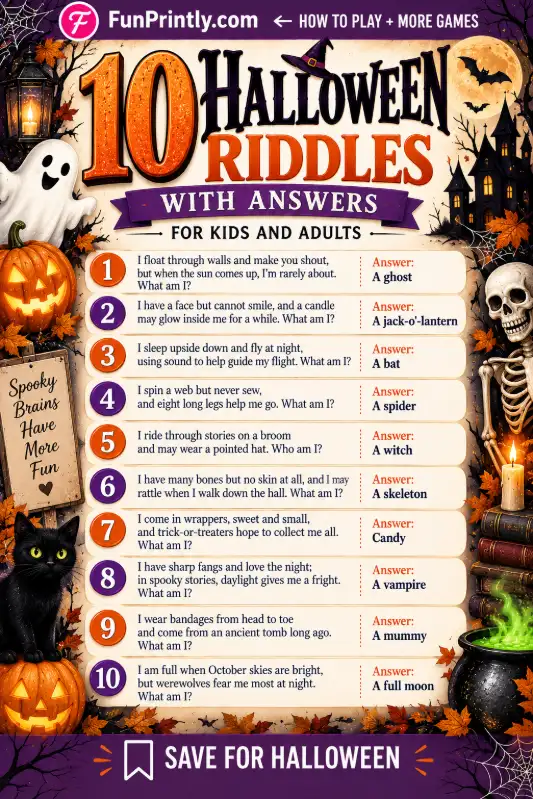
Keep playing with Halloween Party Games, 12 Halloween Emoji Puzzles: Guess the Spooky Word, 12 Halloween Would You Rather Questions for Adults and 10 Halloween Riddles with Answers for Kids and Adults.