When a group is ready for something fun but nobody planned a game, simple is usually best.
These 10 easy party game ideas require little or no preparation and are designed for moments when you want to start playing quickly. Most need nothing beyond the people in the room. Keep this page open on one shared phone, choose a game that matches the group’s energy, and begin.
The collection includes quick choices, guessing, storytelling, acting, memory, and conversation games, so you can switch styles without turning the gathering into a complicated game night.
10 Easy Party Games to Play Right Away
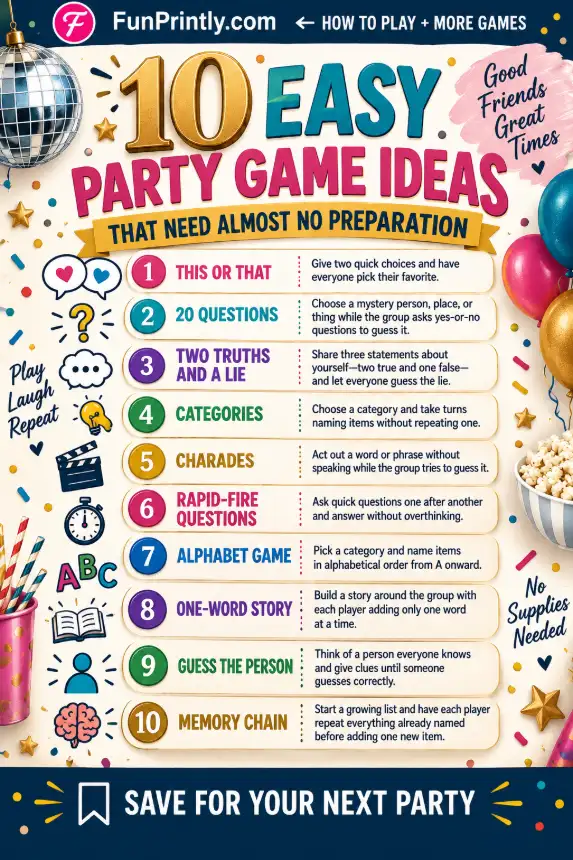
1. THIS OR THAT
Give two quick choices and have everyone pick their favorite.
This is one of the easiest games to use when people are still arriving or the group needs a quick icebreaker.
One person can host from the shared phone and make up two-option choices that fit the group. Everyone can answer aloud, point to one side, or raise a hand.
For a small group, pause when an answer creates an interesting conversation. For a large group, keep the choices coming quickly and have everyone reveal their pick at the same time.
There is no need to score it.
2. 20 QUESTIONS
Choose a mystery person, place, or thing while the group asks yes-or-no questions to guess it.
Choose one player to think of the mystery answer while everyone else takes turns asking questions.
For smaller groups, simply move around the circle. At a larger party, choose a clear order so several people do not shout questions at once.
Keep the pace moving by encouraging short questions and short answers. After one mystery is solved, rotate to a new player.
This works especially well when the group wants a guessing game without props or preparation.
3. TWO TRUTHS AND A LIE
Share three statements about yourself – two true and one false – and let everyone guess the lie.
Give each player a turn to share their own three statements.
The rest of the group listens, makes a guess, and then lets the player reveal which statement was false.
For a casual party, there is no need to keep score. Simply rotate around the group so everyone who wants a turn gets one.
Players should choose their own statements. The host should never invent personal memories, experiences, or facts for someone else.
With a larger group, keep each reveal fairly short so everyone has time to participate.
4. CATEGORIES
Choose a category and take turns naming items without repeating one.
Start with a broad category the whole group can understand.
Friends might choose movies or foods. Families may prefer animals, places, or everyday objects. Mixed-age groups usually work better with accessible categories rather than highly specialized topics.
Move around the group in a clear order and keep answers fairly quick.
If someone repeats an answer, decide before the round whether that ends their turn or simply means the group moves to the next player. That can be a simple house rule.
Rotate who chooses the category so different players can shape the rounds.
5. CHARADES
Act out a word or phrase without speaking while the group tries to guess it.
Charades is a good choice when everyone is ready for something more active.
One player chooses or privately receives something to act out, then performs while the rest of the group guesses.
For a small gathering, everyone can guess together. For a larger party, divide into teams or rotate one actor at a time.
Keep turns short enough that the game stays lively. If nobody is getting close, reveal the answer and move to the next actor instead of letting one round drag.
For mixed-age groups, choose words or phrases that the person acting can reasonably understand.
6. RAPID-FIRE QUESTIONS
Ask quick questions one after another and answer without overthinking.
This game works best when the questions stay easy to answer.
One player can ask while another responds, or one host can move around the group and give everyone a turn.
Keep the questions light and appropriate for the people playing. Players should always be free to skip something they would rather not answer.
For a faster version, give each person several questions in a row before moving to the next player.
For a more conversational version, pause when an answer sparks an interesting reaction.
7. ALPHABET GAME
Pick a category and name items in alphabetical order from A onward.
Choose a category first, then begin with something that starts with A.
The next answer starts with B, then C, and so on.
Move through the alphabet as far as the group can.
For mixed-age gatherings, choose broad categories so younger players have a fair chance to contribute. If one letter becomes too difficult, use a simple house rule that allows the group to skip it and continue.
For a competitive group, keep turns quick. For a relaxed family game, give people a little more thinking time.
8. ONE-WORD STORY
Build a story around the group with each player adding only one word at a time.
Choose one person to begin, then move around the group in order.
Each player adds exactly one word, and the story slowly takes shape.
The fun usually comes from players trying to continue a sentence when they have no idea where the previous person intended it to go.
Keep the turn order clear, especially with a larger group.
If the story reaches a natural ending, stop and start another. There is no need to force one story to continue indefinitely.
This is an easy low-prep group game for friends or families who enjoy silly, unpredictable storytelling.
9. GUESS THE PERSON
Think of a person everyone knows and give clues until someone guesses correctly.
The person can be someone known personally by the group or another person everyone playing can reasonably recognize.
One player gives clues while everyone else guesses.
Start with broader clues and make them more specific as the round continues.
For a large group, have people raise a hand or take turns guessing so the loudest player does not answer every round.
When playing with personal acquaintances, stick to respectful clues and avoid revealing private or embarrassing information.
Rotate the clue-giver after each answer.
10. MEMORY CHAIN
Start a growing list and have each player repeat everything already named before adding one new item.
Sit or stand in a clear order.
The first player begins the list. The next repeats what was already said and adds something new. Each turn makes the chain longer.
Keep the pace steady, but give players enough time to recall the sequence.
For families or casual groups, treat mistakes lightly and restart whenever the chain breaks.
If your group likes competition, you can use a house rule where a missed item ends that player’s round. Keep it simple rather than adding complicated scoring.
How to Choose a Game for the Group
You do not need to play all 10.
If everyone is still settling in, start with a quick choice or question game.
If the group wants movement, choose the acting game.
If people want to be creative, storytelling can shift the mood.
Guessing and memory games work well once everyone is focused and ready for a little challenge.
The best choice is usually the one that matches the energy already in the room.
Play From One Shared Phone
Use one phone only when a chosen game needs prompts or a timer; several of these activities can be explained and played entirely aloud.
The host can choose the next game, explain the mechanic, and help manage turns. For games where another person takes the lead, pass the phone around if needed.
Most of these no-prep party games do not require cards, pens, score sheets, or advance planning.
A phone can also handle an optional timer if your group wants faster rounds, but timing is not required unless you choose to add it as a house rule.
Keep Small Groups Conversational
With a few friends or family members, you can slow things down.
Let everyone have a turn, allow brief explanations, and stay with a game if it is creating good conversation.
There is no reason to rush through all 10 ideas.
One game may be enough for the whole gathering.
Keep Larger Gatherings Organized
Large groups benefit from a little structure.
Choose a host, establish a turn order when necessary, and make sure the same few people are not answering first every time.
For games that involve guessing, simultaneous responses or teams can help more people participate.
If a game stops working for the room, switch to another. With several quick party games available, there is no need to force a round that has lost momentum.
Adjust for Families, Teens, and Adults
The mechanics can stay the same while the content changes to fit the players.
Families and mixed-age groups may want broader categories and more familiar clues.
Teen groups can choose topics they all know.
Adult gatherings can make categories, questions, and mysteries more challenging without making them overly personal.
For games based on personal information, each participant should supply their own facts and decide what they are comfortable sharing.
More No-Prep Games to Try
If everyone wants to keep playing, natural FunPrintly internal-link opportunities include:
- No-Prep Party Games
- Would You Rather
- Most Likely To
- This or That
- Party Game Ideas
- Other group game collections
Switching between conversation, guessing, voting, and active games can give a longer gathering some variety without adding much preparation.
Choose One and Start Playing
Pick the game that fits your group, open it on one phone, and begin.
You can always choose another when everyone is ready for the next round.
SAVE FOR YOUR NEXT PARTY
nnnnnMore Party Games
Browse all Party Games for more games for this celebration.
More Party Game Ideas
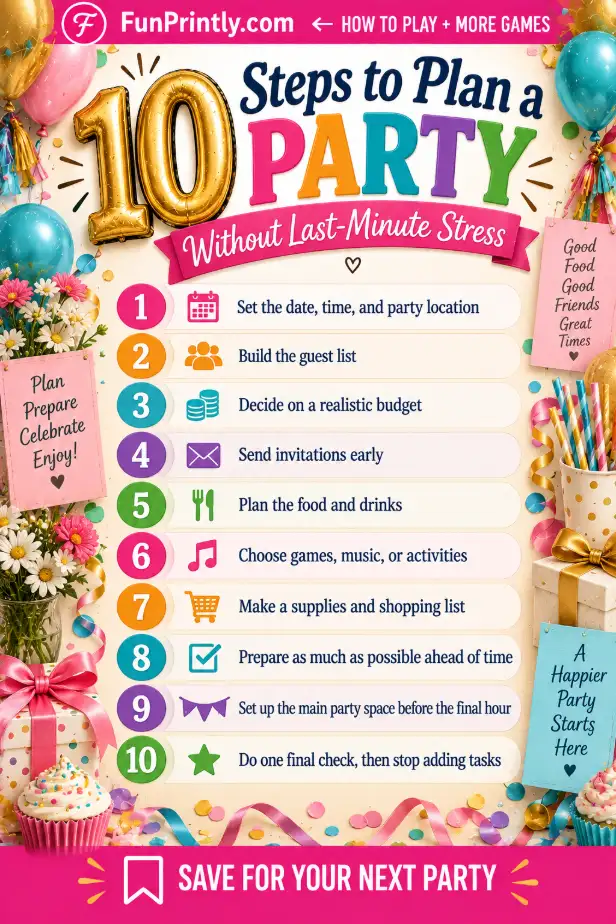
Keep playing with Party Game Ideas and 10 Steps to Plan a Party Without Last-Minute Stress.